
Edinburg Previous Residents Sources
The strongest address history uses sources by era. A current tax or parcel result gives the modern starting identity. Recorded instruments move ownership backward. Historical microfilm carries the Hidalgo deed trail further than the online portal’s disclosed coverage, and directories or census schedules can add the household layer. The table separates what each source can actually show, so an owner record is not confused with evidence about who lived at the address.
| Source | Years It Covers | Where Held | What It Shows |
|---|---|---|---|
| HCAD property search | Current database; start year not displayed | HCAD public portal | Current owner, parcel or legal-description clues, address, tax, appraisal, and exemption information. |
| Hidalgo tax account | Current records; online start not displayed | County Tax Office portal | Owner, property address, account, CAD reference, tax balance, and statement tools. |
| Official-record index | Current portal certified through 08/24/2026; start year not displayed | Hidalgo County Clerk publicsearch.us | Recorded parties, dates, document type, document number, and legal-description fields. |
| Deed-record microfilm | 1852–1888; supplement 1880–1912; Spanish-transcribed 1854–1896 | UTRGV / Texas State Library guide and county originals | Direct and reverse indexes, deeds, bills of sale, mortgages, and related instruments. |
| County tax rolls and probate minutes | Tax rolls 1852–1910; probate minutes 1852–1911 | UTRGV / Texas State Library microfilm guide | Historic property and taxable-owner clues, estate proceedings, and heir names. |
| Edinburg directories | 1941, 1943, 1945, 1947, 1949, 1952, 1954, 1957 located | Archive and library leads | Address-to-occupant entries, spouse, phone, and status details when present. |
| Federal census | 1850–1950 public under the 72-year rule | NARA, Census, and library databases | Household composition, age, relationship, occupation, and enumeration residence. |
Start with the current parcel and transfer chain for an ownership question. Start with a dated directory or census only after the parcel’s address and legal description have been checked against the period being studied.
Start an Edinburg Address Timeline
Begin by collecting the current HCAD property-search legal description, situs address, owner name, account or CAD reference, and any displayed geo ID. HCAD search instructions favor a street number plus street name, without a directional prefix or suffix. The county tax portal is a second current-era route: it searches an owner name, property address, account number, CAD reference, or fiduciary number and allows an optional second criterion. These tools create a present-day anchor. They do not reveal the complete earlier history by themselves.
Make a timeline entry for each record with the party spelling, role, instrument date, recording date, document number or book-page reference, legal description, and any connection back to the modern address. Keep the instrument date separate from the recording date. An old street number may change, and a transfer can use a lot, block, subdivision, acreage, abstract, or metes-and-bounds description instead. The legal description is the more reliable bridge across those changes.
Note: A change in the tax mailing address or an exemption record does not by itself prove where a past owner or other person lived.
Follow Edinburg Previous Residents Deeds
Hidalgo County official records provide the backward transfer method. Use Advanced Search with Department set to Property Records. Search the current owner as grantee to locate the acquisition deed, or as Party Name if the role is not known. Then read the transfer to identify the earlier owner and search that seller as grantee in an earlier date range. Grantor and grantee searches should be tested separately, especially where a party name is indexed with an initial, an accent, a compound surname, or a different name order.
- Copy the current parcel’s situs address and legal description from HCAD or the tax result.
- Search the current owner as grantee in the Clerk’s advanced Property Records index. Use recorded and instrument dates to narrow the result.
- Open the index result and record party roles, instrument type, dates, document number, book or volume and page, and legal description. Note whether an image is available rather than assuming it is.
- Read the acquisition deed for the prior owner or seller. Search that person as a grantee before the later acquisition date.
- Repeat the process, testing Lot, Block, subdivision, and Legal Description when the address search fails. Check plats, liens, releases, deeds of trust, foreclosures, judgments, and easements when a sequence breaks.
- When the portal does not return an older record, use the County Clerk counter, its written-request and forms route, county originals, or the historical microfilm route.
The Hidalgo County advanced official-records search provides the documented department, party-role, date, document-number, lot, block, and legal-description fields.
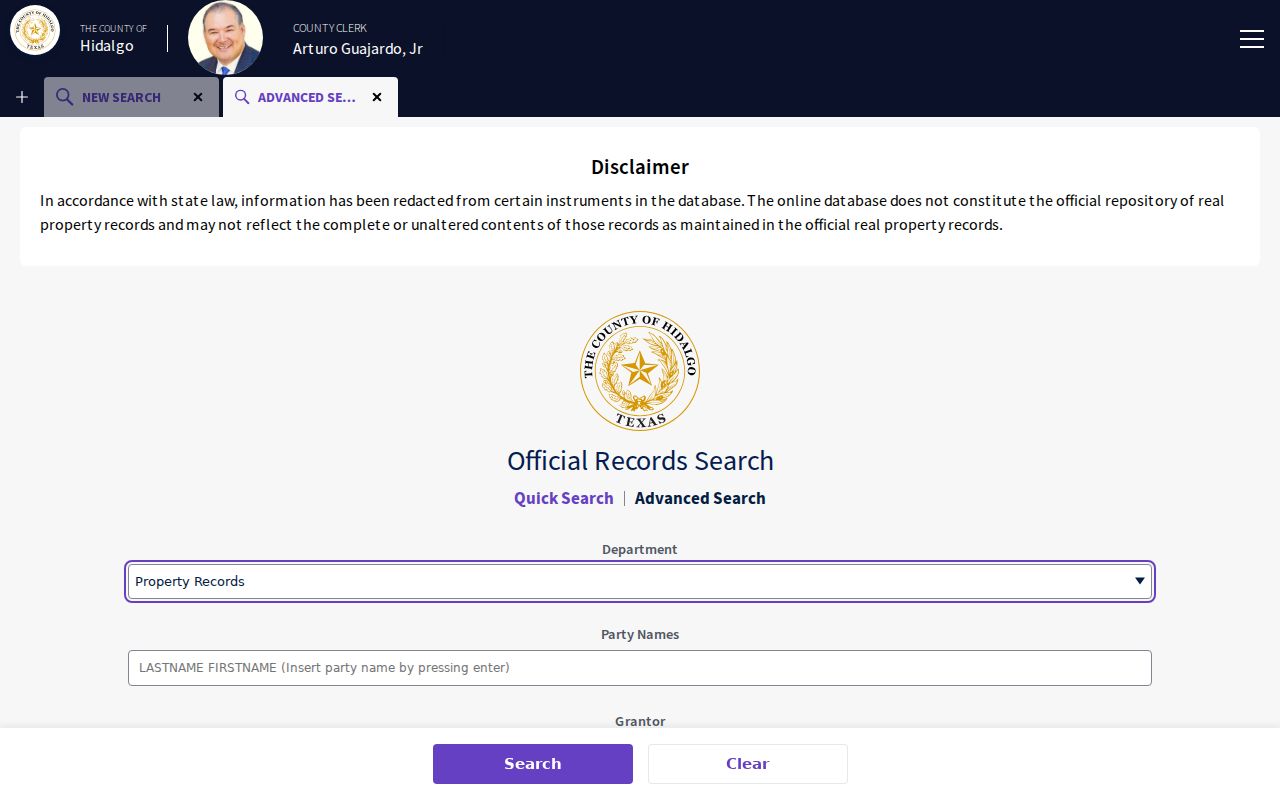
The portal was certified through August 24, 2026 when inspected, but its earliest online year, image pricing, and complete image coverage were not exposed. An absent web result is therefore not proof that an older deed was never recorded.
Edinburg Title Trail Terms
A few title terms make the backward search easier to read. Use the role displayed in the record rather than assuming that every named party has the same relationship to the property. The same legal description should recur across the chain, even if the street wording does not.
- Grantor
- The person or entity transferring an interest in a recorded instrument. In a purchase deed, this is commonly the seller.
- Grantee
- The person or entity receiving an interest. Searching the earlier grantee is the usual way to move one deed farther back.
- Chain of title
- The sequence of recorded transfers and related instruments used to follow ownership of the same parcel through time.
- Legal description
- The land identity written in deeds and plats, such as a subdivision, lot, block, acreage, abstract, or metes-and-bounds description. It is often stronger than an old address label.
Past residents are not established solely by a title chain. The chain documents ownership or an interest in land; dated directory, census, probate, or obituary records may add separate evidence about a household.
Use Edinburg Deed Microfilm
When the online trail ends, the Texas State Library and Archives Commission’s Hidalgo guide supplies the documented historical bridge. It lists direct and reverse deed indexes and record volumes at UTRGV in Edinburg, along with county tax rolls, probate material, court minutes, marriage records, and survey or field notes. The microfilm inventory reaches the 1850s, while the online portal did not disclose its first available year. Obtain the relevant reel and year range before travel or an interlibrary-loan inquiry, and do not assume every case paper was filmed.
The Texas State Library Hidalgo microfilm inventory identifies the deed, tax-roll, probate, and court record ranges.
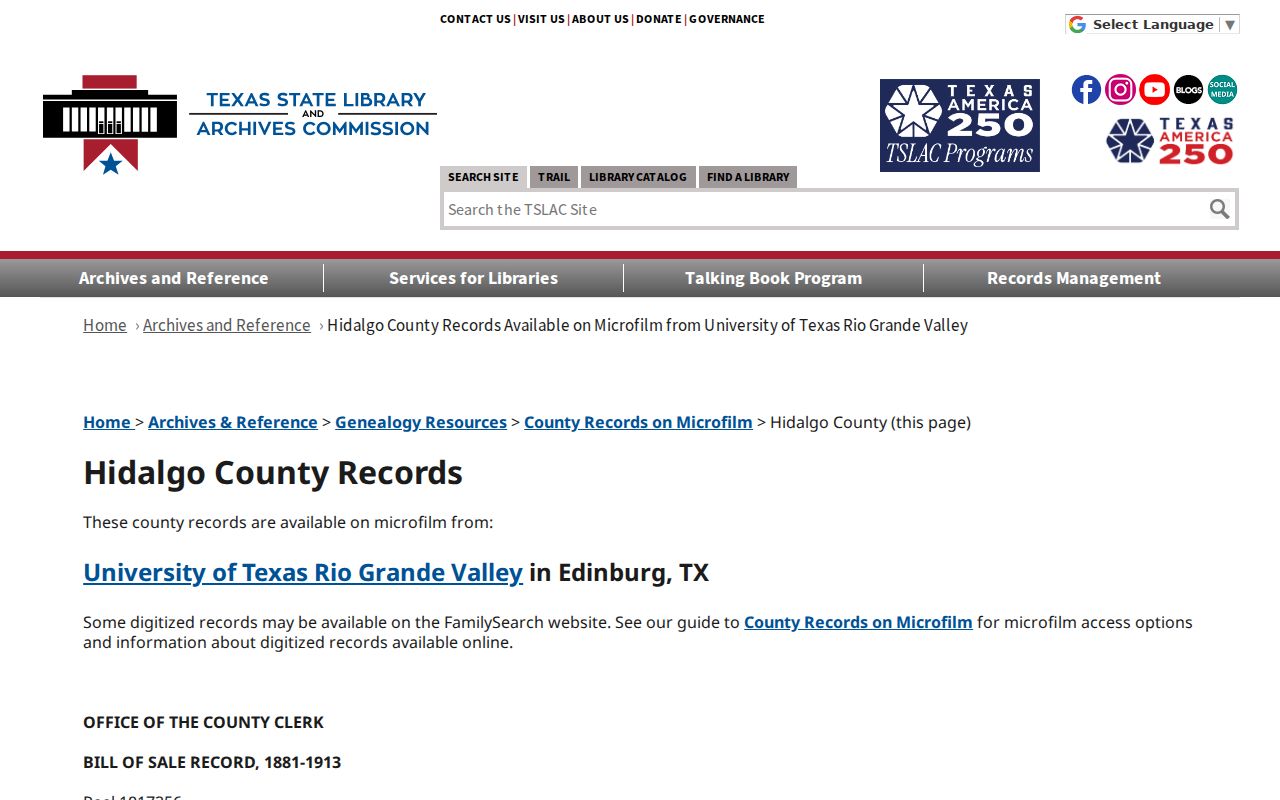
UTRGV is the Edinburg depository named in the guide. Microfilm can be used onsite or through the documented loan route where available; call or email about the reel, since staff do not perform the underlying search on request.
Pair Edinburg Directories and Census
Ownership is only one part of who lived here before. A historical directory can give a contemporary address and, depending on the edition, a spouse, telephone, occupation, or status notation. The federal census can supply a household at its enumeration date. Located Edinburg directory years are intermittent, so treat the space between them as a records gap. Use an exact spelling log for Spanish accents, compound surnames, initials, maiden or married names, and abbreviations.
- Choose the directory year closest to the address event already anchored by the deed chain.
- Copy the address, exact name form, spouse notation, telephone, and abbreviations from the volume, including the edition date.
- Use a street or criss-cross section only if the volume actually contains one. A reverse section was not verified for each Edinburg edition.
- Pair the result with the nearest available federal census year and compare household relationships, ages, and address context.
- Resolve a conflict through the parcel legal description, a later deed, probate, a newspaper, or another dated custodian record.
The underlying volume runs and entry formats are collected with the Edinburg city directory resources. That collection work supports an address timeline without replacing the deed-by-deed property trail.
Close Edinburg Past Resident Trails
Probate and obituary sources can explain what happened after an address disappears from a transfer trail. Hidalgo probate minutes on microfilm run from 1852 through 1911, with a case-paper index, although the guide notes that not every case paper was filmed. For a later estate, look for a County Clerk probate record, a modern probate docket, and recorded estate instruments that repeat the parcel’s legal description. An obituary, cemetery deed, newspaper notice, or death record may supply a date, spouse, heirs, executor, or last-known residence, but each has its own access rule.
Sekula Memorial Library is the local catalog and newspaper referral point. MOSTHistory’s Margaret H. McAllen Memorial Archives holds land-title, agricultural, photo-studio, business-image, and newspaper-photo collections and accepts archive research by appointment. Those sources can add context to a property history, but no official Edinburg house-history service, local obituary index, or exact library directory shelf was located. Treat those as questions for the custodian, not established coverage.
Bridge Chapin and Edinburg Records
Edinburg address history has a local naming trap. The county-seat settlement selected in 1908 was called Chapin and was renamed Edinburg by 1911. Earlier material can therefore use Chapin, Edinburg, Hidalgo, or only a county and legal-description reference. The city’s development history also places irrigation in 1915, a change that accelerated development. Search those names alongside the county and legal description instead of limiting an early query to today’s city field.
A local historical clue for an old house research project is that a failed modern-place search can reflect a historic name rather than the absence of a record. Confirm the matching tract with the Clerk or archive before attaching an earlier document to an Edinburg address.
Edinburg Previous Residents Limits
A deed chain proves recorded transfers, not a complete household roster. Directory entries may be missing or abbreviated, and census residence is tied to its own enumeration date. A permit applicant, a mailing address, or an estate party may have a connection to the parcel without showing who was present there on every date. Protected addresses, restricted records, and missing historical runs create further gaps. Write “not located” rather than filling a gap with an assumption.
Lawful use. Edinburg previous-resident research belongs in house history, family history, estate research, and personal curiosity. Do not use names or addresses to stalk, harass, intimidate, or harm anyone.