
Edinburg City Directory Collections
The located Edinburg directory list contains eight mid-century years: 1941, 1943, 1945, 1947, 1949, 1952, 1954, and 1957. That is a set of located years, not proof of a complete annual run. The catalog material does not name a publisher for each Edinburg volume, does not confirm a local shelf location, and does not verify a reverse-directory volume. Check a title page and a holding catalog before citing a publisher or format.
| Collection | Years | Where held | Access |
|---|---|---|---|
| Located Edinburg city directories | 1941, 1943, 1945, 1947, 1949, 1952, 1954, 1957 | Historical-image and library-catalog leads | Subscription or onsite access can vary; title-page details need confirmation |
| Portal to Texas History city-directory collection | Broad collection, 361 items over 137 years | University of North Texas digital collection | Free page-image portal; verify an Edinburg item by title and year |
| Texas State Library city directories | Statewide print and microform | Reference Reading Room, Austin | Onsite use; staff do not search or transcribe by phone or email |
| Texas directories at UT collections | Late nineteenth century to present, exact Edinburg scope unverified | Dolph Briscoe Center, UT Austin | Catalog and onsite research |
| Local discovery routes | Varies by catalog result | Sekula Library, WorldCat, and interlibrary discovery | Ask about title, place, year, telephone books, and reverse directories |
The Texas State Library city-directory guide explains the standard sections and routes to both digitized and onsite collections. Its captured guide page is shown below. It gives a dependable way to interpret a volume, but it does not establish which titles are on an Edinburg shelf.
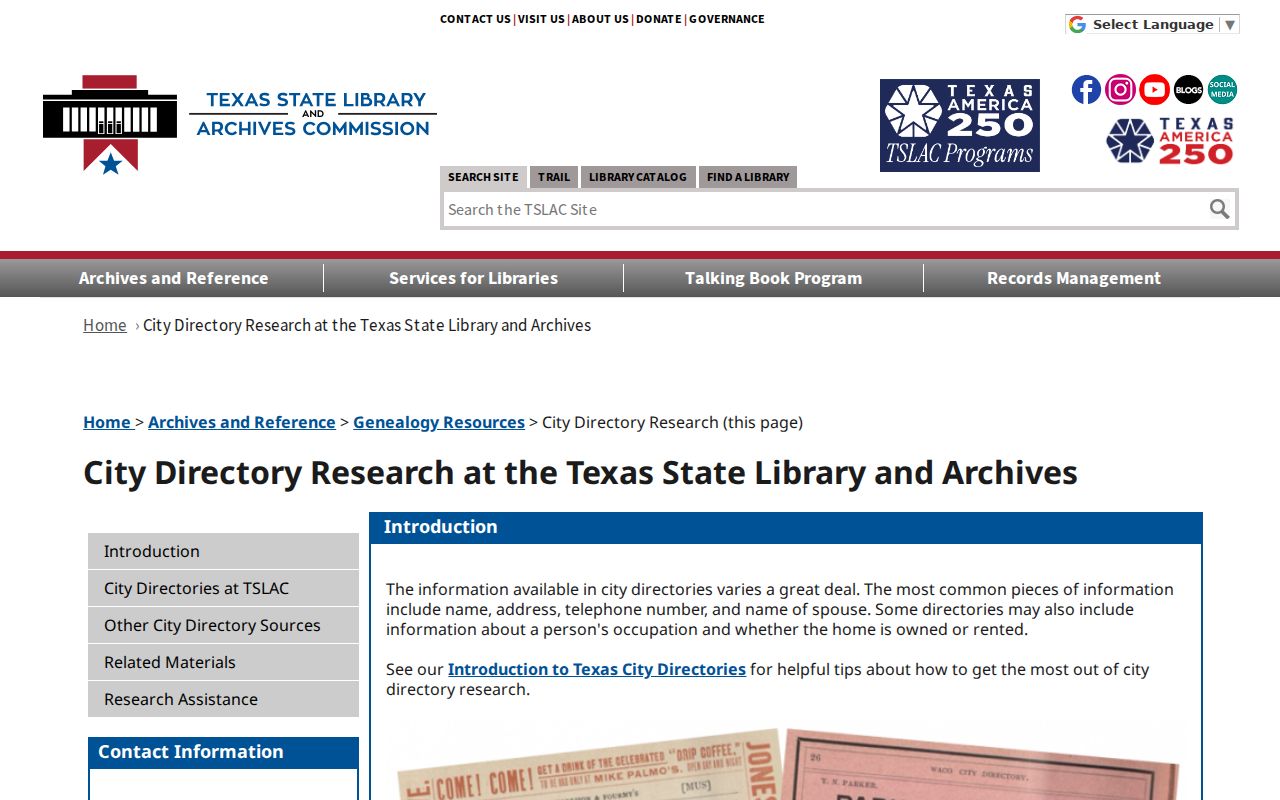
Collection gaps are evidence gaps. If a name appears in 1947 and not 1949, the result may reflect a move, an omission, a name variation, or an unavailable volume. It is not proof that the person was absent from Edinburg for the entire interval.
Edinburg Digitized Directory Volumes
The Portal to Texas History city-directory collection offers year browsing across a broad digitized collection. A year appearing in the collection is not, by itself, an Edinburg result. Open the item and verify the city, title, publication year, and page image before attaching it to an Edinburg household trail. The portal is useful because it preserves the page context that a bare name hit can lose.
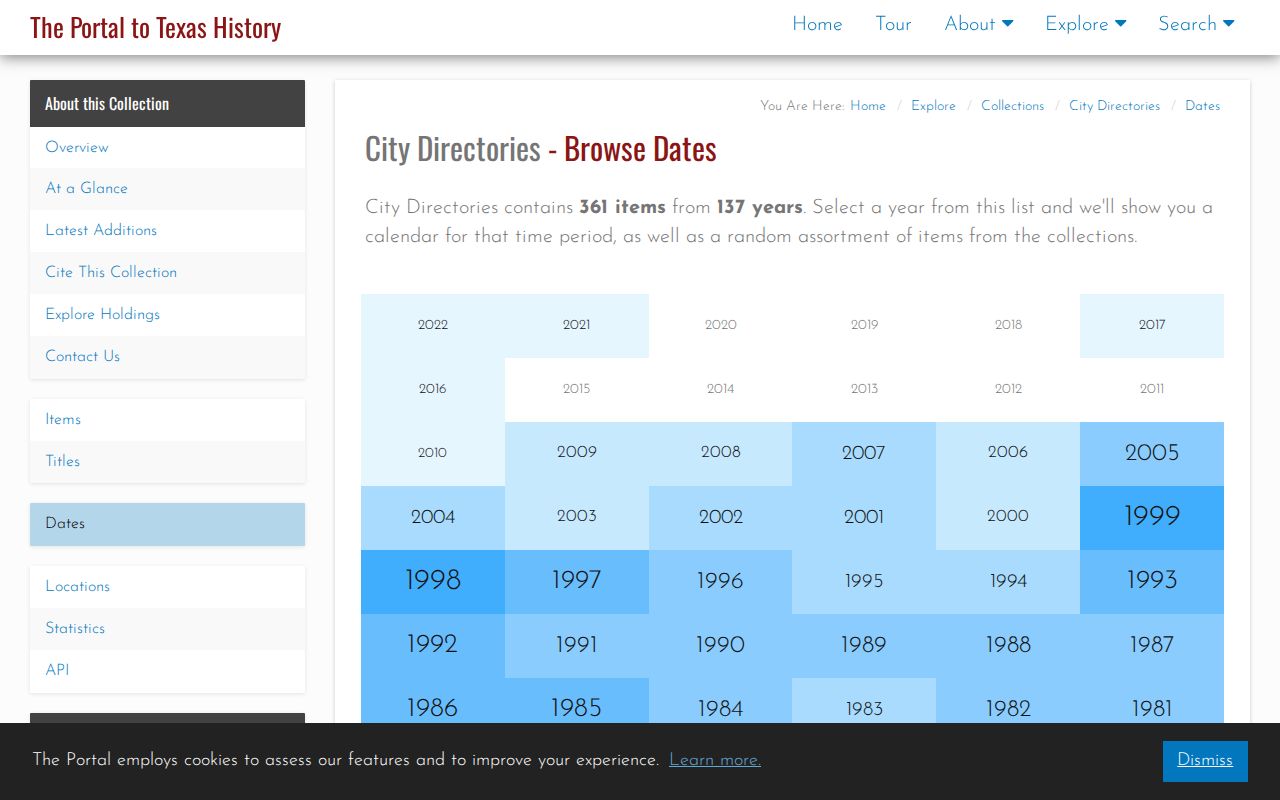
The browse-by-year view makes it easier to see where digitized coverage begins and ends. For titles not online, the Texas State Library guide points to library access routes, including participating-library databases. Availability can depend on the library account, the institution, and restrictions on the particular image collection.
Note: Save the collection title and image page with the transcription, because a search-result snippet cannot show an abbreviation key or neighboring entry.
Edinburg Historical Directory Desk
Dustin M. Sekula Memorial Library is the practical local starting point for a directory search. It is at 1906 S. Closner Blvd., Edinburg, Texas 78539, and its published phone number is 956-383-6246. The official page lists the library catalog, Hidalgo catalog, NewsStand, TexShare databases, and other electronic resources. It does not list a verified genealogy-room finding aid, an Edinburg directory shelf, a reverse directory, or an obituary index.
The library page below confirms the local catalog and electronic-resource access point. Before traveling, call and ask specifically about Edinburg city directories, telephone books, high-school yearbooks, local newspaper holdings, obituary materials, and whether a relevant historical-image database is currently available. Those questions are more useful than assuming a collection is on the shelf.

Published library hours are Monday through Thursday 9 a.m. to 9 p.m., Friday 9 a.m. to 6 p.m., Saturday 11 a.m. to 3 p.m., and Sunday 1 p.m. to 5 p.m. Confirm them before a visit. A catalog result or staff referral can point to a nearby holding without claiming that the library owns a particular Edinburg volume.
Reading an Edinburg Directory Entry
Texas State Library describes common city-directory fields as name, address, telephone number, and spouse name. Some entries add an occupation or a residence-status mark. The exact format and abbreviation key for a local Edinburg scan were not exposed in the research, so each mark must be read from the volume in hand. An entry is a historical editorial listing, not a legal determination of property ownership or a current-address confirmation.
| Alphabetical name | Surname, given name, initial, or a separate spouse or household-adult line. |
|---|---|
| Residential address | Street number, street name, directional detail, and sometimes a room or unit notation. |
| Telephone | An exchange or number in telephone-era books, where included. |
| Spouse or widow notation | A relationship clue that should be copied exactly and compared with other dated records. |
| Occupation or business line | Historic context when printed; it can connect an entry to a business address but does not prove a current association. |
| Residence-status mark | A mark may appear in some books; read the volume's own key rather than assuming its meaning. |
- Criss-cross directory
- A directory arranged by street or address instead of only by name. Its local Edinburg format and years have not been verified.
- Householder index
- An arrangement that identifies the named household contact. It may omit other people at the same address.
- Abbreviation key
- The explanatory list, commonly near the front of a volume, that defines the publisher's own short forms and should be copied with an entry.
- Numerical telephone list
- A section arranged by number where supplied. It can help interpret a period listing but may not identify every person using a line.
Edinburg Directory Clues at MOSTHistory
The Margaret H. McAllen Memorial Archives at MOSTHistory is a regional complement to an Edinburg city directory. Located at 200 N. Closner Blvd. in Edinburg, it holds South Texas photographs and historical documents, with strengths in land-title, citrus and agriculture materials, photo-studio records, local business images, newspaper and photo-lab collections, and borderland history. A surname or address from a directory can guide a focused archive request for context.
The archive's page below records the appointment-based access model. Archivist contact and reading-room hours are published by the archive, and only archive staff may photocopy collection documents. Reproductions can be purchased subject to the archive's terms. That makes a dated directory entry a useful starting point for a photo, newspaper, land-title, or institution lead, not proof that every person appears in its collections.
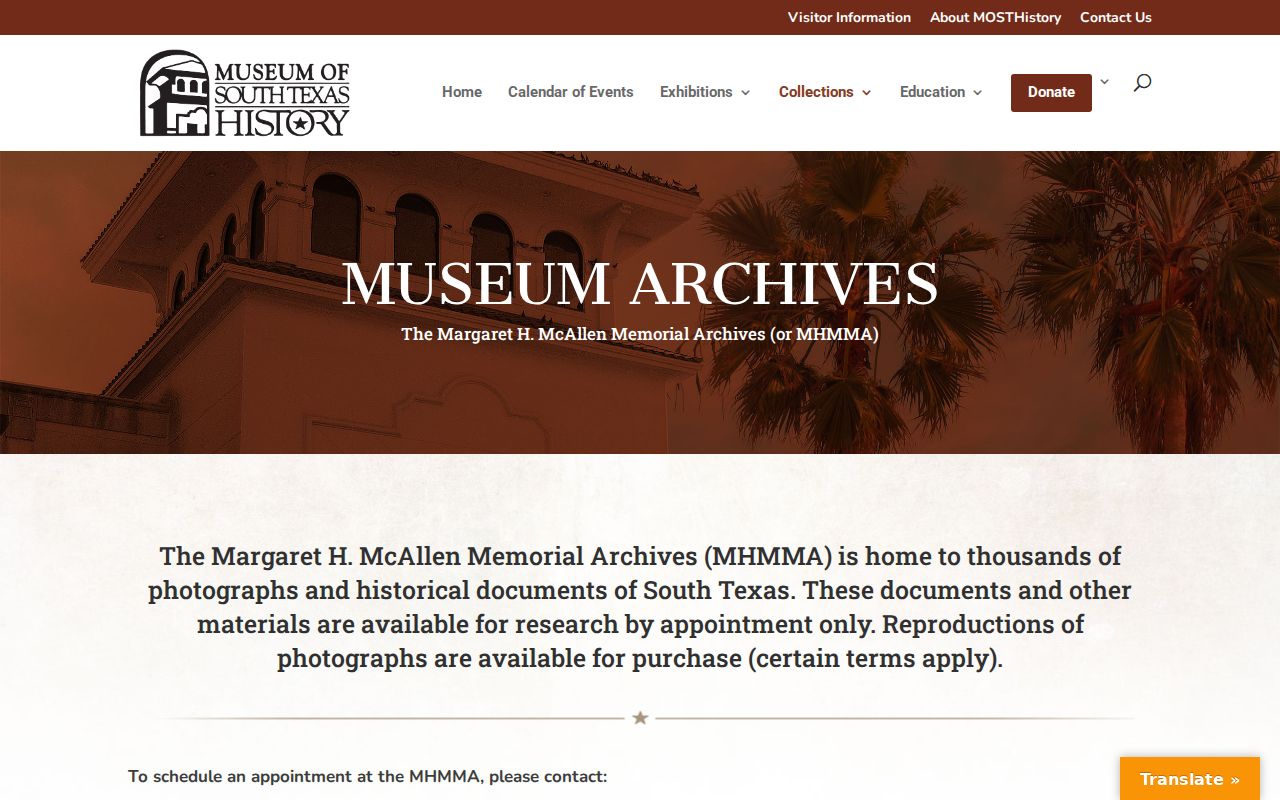
MOSTHistory preserves a story layer that printed directories cannot: regional land, agricultural, business, and visual history. An appointment request is strongest when it includes the exact name variation, address, date span, and the type of material sought.
Edinburg Directory Year Markers
The located year list supports a modest timeline, but not a full publication history. It does not identify publisher changes, a first-ever Edinburg volume, or the final printed directory. Treat the dates below as verified finds from the research inventory, with unlocated years left open rather than filled by assumption.
- 1941: earliest located Edinburg city-directory year in the research list.
- 1943, 1945, 1947, and 1949: additional located mid-century years, each requiring title-page verification before formal citation.
- 1952, 1954, and 1957: later located entries in the same research list.
- After 1957: no conclusion about publication or local holdings can be made from the located list alone.
The city history supplies another useful date boundary. The county seat moved to the settlement known as Chapin in 1908, and the settlement was renamed Edinburg by 1911. A pre-1911 newspaper or directory-related lead may therefore use Chapin, Edinburg, or a broader Hidalgo label.
Tracing Edinburg Directory Families
Use an Edinburg city directory as a sequence of dated observations. Each volume can preserve spelling, initials, spouse notation, address, telephone, and a small amount of context. The located run is not annual, so a blank year is a gap in the evidence. Pairing a directory with a public census, recorded deed, probate record, obituary, or newspaper item helps determine whether a similar name is the same person.
- Start with the nearest located year to a known Edinburg name or address and record every printed field exactly.
- Check nearby located years in both directions, retaining the page number and the volume's abbreviation key.
- If a street section is present, use it as an address test. Do not presume one exists in an Edinburg volume until the scan confirms it.
- Pair the dates with federal census years. As of the research date, 1850 through 1950 censuses are public under the 72-year rule, with 1950 the latest fully open decennial census.
- Resolve name changes and moves with a deed, probate, marriage, newspaper, or obituary source, then confirm a modern parcel separately if needed.
A disappearance can mean many things: a move, a changed spelling, a different listing convention, a missing volume, or an unlocated collection. It should never be treated as a final conclusion without another dated source. For a property-centered trail, move next to the previous residents record sequence.
Edinburg Directory Gaps and Microfilm
When a city-directory trail stops, Hidalgo County records can provide the older bridge. The Texas State Library Hidalgo microfilm inventory lists deed records from 1852 through 1888, an 1880 through 1912 supplement, Spanish-transcribed deeds from 1854 through 1896, marriage records, tax rolls, probate minutes, court minutes, and direct and reverse deed indexes. UTRGV in Edinburg is named as a repository for the county reels.
The microfilm holdings table is shown below. It does not turn a deed index into a city directory. Instead, it gives a way to test a surname, legal description, estate, or historic address when a printed directory supplies only a partial lead. Repository access and interlibrary loan are the documented routes; staff do not search the reels or make copies for a researcher.
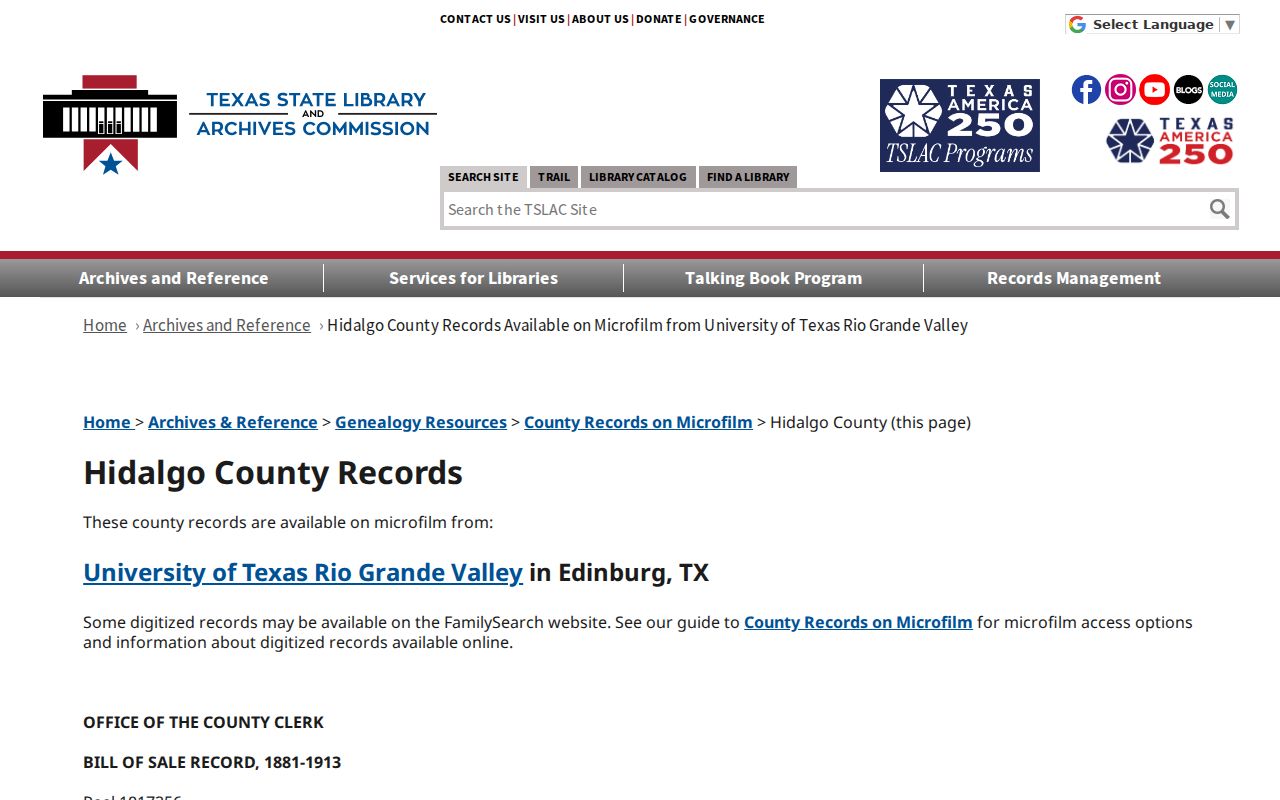
Note: The microfilm guide reports a case-paper index for probate, but also says some case papers were not filmed.
Edinburg Directory Evidence Limits
A city directory is best read as a dated publication. It can show that an editor printed a name, address, number, spouse notation, or business context in a particular issue. It cannot independently prove property title, current occupancy, family relationship, or the reason someone did not appear. The County Clerk's recorded instruments, the HCAD property record, and vital or court records each have their own access rules and are separate evidence.
Use historical material for family history, reconnecting with relatives, estate research, local history, or a property timeline. Respect confidentiality limits and personal safety. Texas's Address Confidentiality Program can provide a substitute address for eligible participants, and court or vital records can be sealed or restricted. Confirm consequential facts with the custodian that maintains the record.